Is it safe to use chemical drain cleaner on a clog?
Chemical drain cleaner is best avoided on anything beyond a simple sink clog, and there are mechanical reasons for that. The liquid runs around a solid clog rather than through it, so it can sit in the pipe for hours without breaking anything loose. What it leaves behind is caustic. When a plumber then feeds a cable or a camera into that line, the standing chemical can splash or burn skin and eyes. Tell the plumber if you used any. On older galvanized or cast iron pipe, the chemicals can also worsen corrosion on a wall that is already rough or thin. In a bellied section they pool and stay in contact with the pipe far longer than intended. Never mix two products, and never use them in a toilet or in a line that is backing up from several drains. A plunger or a hand drain snake is the safer first step for one slow fixture. If a plunger or snake does not clear a single sink or tub, or if more than one drain is affected, the job needs a cable machine or hydro jetting from an independent plumber. Expert Plumbers Co can connect you with one in Bay, AR who handles this.
If you have already used a chemical product, the safest steps are simple. Do not add a second product or hot water on top of it, and do not run a plunger hard, since the splashback can contain caustic liquid. Wear gloves and eye protection if you need to go near the drain, and keep the room ventilated, because fumes can be strong in small bathrooms. Write down the product name and roughly how much was used, or keep the bottle, so the plumber can see the ingredients and take care when opening the trap. Pour no more down the line after you have called. A plunger used gently and a hand-operated drain snake do the same job without chemistry. Foaming enzyme products are milder, but they work slowly and only on soft organic buildup, not on hair, roots, or a damaged pipe. When in doubt, wait for the plumber.
We just built or remodeled and the drains are already slow. Why?
The plumbing is new, and the tub drains like an old one. Or the sink gurgles whenever the washer runs. New work should not do this, and the cause is usually in how the pipe was set.
Four causes come up. First, not enough fall on a horizontal run. Water needs slope to carry solids, and a flat run leaves them behind. Second, a vent that was never tied in or was capped. The line cannot breathe, so you get gurgling and slow flow with no clog. Third, construction debris left in the line: grout, drywall mud, thinset, sand. It sets hard on the pipe wall. Fourth, a trap arm run too long.
One slow fixture points to its own trap arm, slope or vent. Several fixtures slow together, or the lowest drain backing up, points to the main run, a debris plug or a vent problem.
Safe homeowner check: note which fixtures are slow and listen for gurgling. Do not climb onto the roof. Stop running water and call now if water or sewage comes up in a tub or floor drain.
A camera inspection is the right first step on new work. It shows a flat section, a ridge of hardened material on the pipe wall, or a vent that never connected. Repeat cabling just pokes a hole through the problem, and it returns. A cable machine is enough for a soft, loose blockage. Hardened cementitious debris often needs hydro jetting. Slope and vent faults need the piping corrected, and what that involves follows access, materials, how much has to be opened up, and any permit or inspection.
Expert Plumbers Co is a referral service. We refer homeowners in Bay, AR to an independent local plumber for Drain Cleaning and Emergency Drain Cleaning. Call (380) 262-9173.
Keep a record while the work is fresh. Photograph any open walls or trenches before they are closed, and write down the date the slow drains first showed up. If a builder or remodeling contractor did the work, the fault may be theirs to answer for. A written note from the plumber describing what the camera found, such as a flat section or hardened debris, helps far more than a general complaint.
Tell the plumber when the work finished, which fixtures were added and whether the main line was touched.
A common mistake is pouring strong drain chemicals into a new line. They rarely touch hardened grout or thinset, they can damage fittings, and they make later cabling or jetting unsafe for whoever handles it. Another is waiting for the problem to settle. Construction debris does not wash away. Ask whether any air admittance valves were used in place of a full vent, and whether local code allows them.
Can I rent a hydro jetter or a big drain machine and do the main line myself?
"Can I just rent a hydro jetter and do the main line myself?" You can rent one at many tool shops, so it is a fair question. The honest answer is that it is a bad bet on a main line, for reasons of both pipe and safety.
A hydro jetter pushes water at very high pressure through a hose with a nozzle that pulls itself down the pipe. In the right hands, on sound pipe, it cleans grease and scale off the pipe wall. In the wrong hands it can break old clay or cast iron, wash out joints, drive water into a cracked pipe, or punch through a thin spot. Root intrusion at a clay joint can hold the nozzle, and a bellied line can trap it.
A large drain machine has its own risk. The spinning cable can whip, snag and twist. It can wrap a hand or arm in a second.
There is a bigger issue. Without a camera, you do not know what you are cutting. A main line that backs up may be roots, a bellied line, a collapsed section or a failed sewer lateral. Clearing the blockage may only open a hole through it, and it returns soon after.
Safe homeowner check: Run one fixture at a time and note which drains slowly. Check if it is one fixture or every drain in the house. Do not pour drain chemicals into a line that is backing up.
Stop running water and call now if sewage is coming up in a tub, shower or floor drain, the toilet bubbles or rises when you run other fixtures, or you smell sewage in the house. Stop using water in the house until the line is cleared.
A cable machine is enough for a simple clog in a branch line. Hydro jetting is for grease and scale on the pipe wall. A camera inspection is the step that tells the plumber what is in the pipe and what tool is safe to use, which is what a rental cannot give you.
Expert Plumbers Co is a referral service. We connect you with an independent local plumber in Bay, AR. Call (380) 262-9173.
Ask the plumber to show you the camera footage and explain what was found. Ask whether the pipe is sound enough for jetting. Cost depends on access to a cleanout, the parts or materials needed, how much has to be opened up or removed to reach a damaged section, and any permit or code requirement.
Will baking soda and vinegar, or a kettle of boiling water, clear a slow drain?
You have a slow drain, so you tried baking soda and vinegar, or a kettle of boiling water. It still crawls, or the clog is back by morning. That is the usual result.
The fizz is mild. It can freshen a drain, but it does nothing to a solid clog of hair, soap scum, grease or paper. Boiling water melts grease for a moment, then the grease cools and sets again further down the pipe, where it is harder to reach. Boiling water can also soften PVC joints and crack porcelain. Hot tap water is safer than a kettle.
The real causes sit deeper: grease build-up on the pipe wall, scale in old cast iron, roots entering a clay joint on the main, or a bellied line that holds water and solids at its low point. A blocked vent stack can also make a drain sluggish and gurgling, which looks like a clog but is an air problem.
Count the affected drains. One slow fixture usually means a hair, soap or grease clog in that fixture or its branch. If the tub, sinks and toilets all run slow together, or you hear gurgling after a flush, the trouble is in the main line or vent, and no kitchen remedy will reach it.
Safe homeowner check: Remove the stopper or strainer and clear hair and residue by hand. Try a plunger with a good seal. Run hot tap water, not boiling. Check whether other fixtures are slow. Avoid stacking store-bought chemical cleaners, which can sit in a standing pipe.
Stop running water and call now if more than one fixture is backing up, if dark water is rising in a tub or floor drain, if you smell sewage, or if water comes up when you flush or drain the washer.
A cable machine is usually enough for a clog in a single branch. Hydro jetting is the better tool when grease or scale coats the pipe wall. A camera inspection is the right step when the drain clears and slows again within days, since that pattern points to a belly, roots or a damaged section.
Expert Plumbers Co is a referral service. We connect you with an independent local plumber in Bay, AR. Call (380) 262-9173.
Tell the plumber what you already tried. Ask what they found in the line, not only that it was cleared. The scope depends on access to the pipe, whether a fixture has to be removed, the pipe material, and whether the cause is a simple clog or damage that needs repair.
The city is replacing the street main outside our house. Why are our drains acting up now?
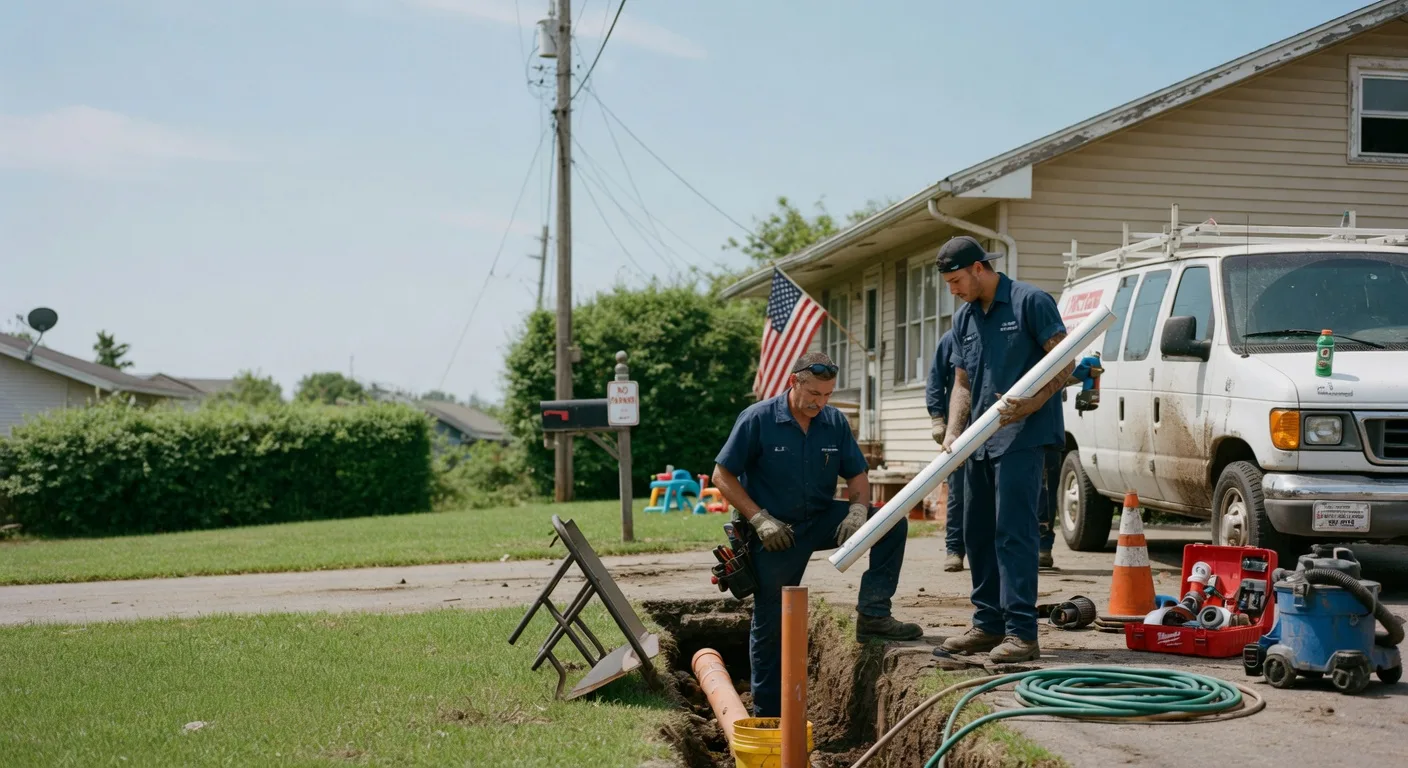
The crew has been digging up the street for a week, and now your toilets gurgle, the tub drains slowly, or you saw muddy water in a floor drain. It is natural to suspect the work outside. There are a few real reasons why it can be connected.
Your house drain, called the lateral, runs from your foundation to a connection on the city main. When the main is dug up and replaced, that connection is cut and reattached. Vibration, trench work and heavy equipment can crack an older clay or cast iron lateral, push a joint out of line, or shift the pipe so water now pools in a low spot. Dirt, gravel and construction debris can also wash into the line while connections are open. The work can also cause temporary backups while flow is being rerouted or the new pipe is flushed.
The key question is whether it is one fixture or the whole house. A single slow sink is probably the fixture. If every drain is sluggish, gurgling or backing up at once, particularly the lowest ones, the trouble is in the lateral or the main, and the street work is a likely suspect.
Safe homeowner check: write down when the symptoms began and compare that to when work started near your address. Take photos of any muddy water, debris or wet floor. Check whether neighbors have the same trouble. Run one tap for a minute and see if the lowest drain in the house reacts.
Stop running water and call now if sewage is coming up in a tub or floor drain, if there is standing water in the basement, or if you smell sewage inside the house. Do not keep using the washer or dishwasher.
Tell the utility or the contractor promptly. They may have a claims process, and a delay can make it harder to show when the damage started. A cable machine may be enough if loose debris is the problem. If the lateral is cracked, offset or holding water, the plumber will need a camera inspection to see the damage, and hydro jetting can flush out silt and gravel.
Expert Plumbers Co is a referral service. We connect you with an independent local plumber in Bay, AR. Call (380) 262-9173.
Ask the plumber to record the camera inspection and write down the footage location of any damage, so you can give it to the city or contractor. Scope depends on how deep the pipe is, how much has to be dug up or opened, parts and materials, and any permit or code requirement. Responsibility for the repair varies by area, so confirm who owns which section of the line.